
By Uriah Kumadoh
Go to school. Get a job. Save money. Buy a home.
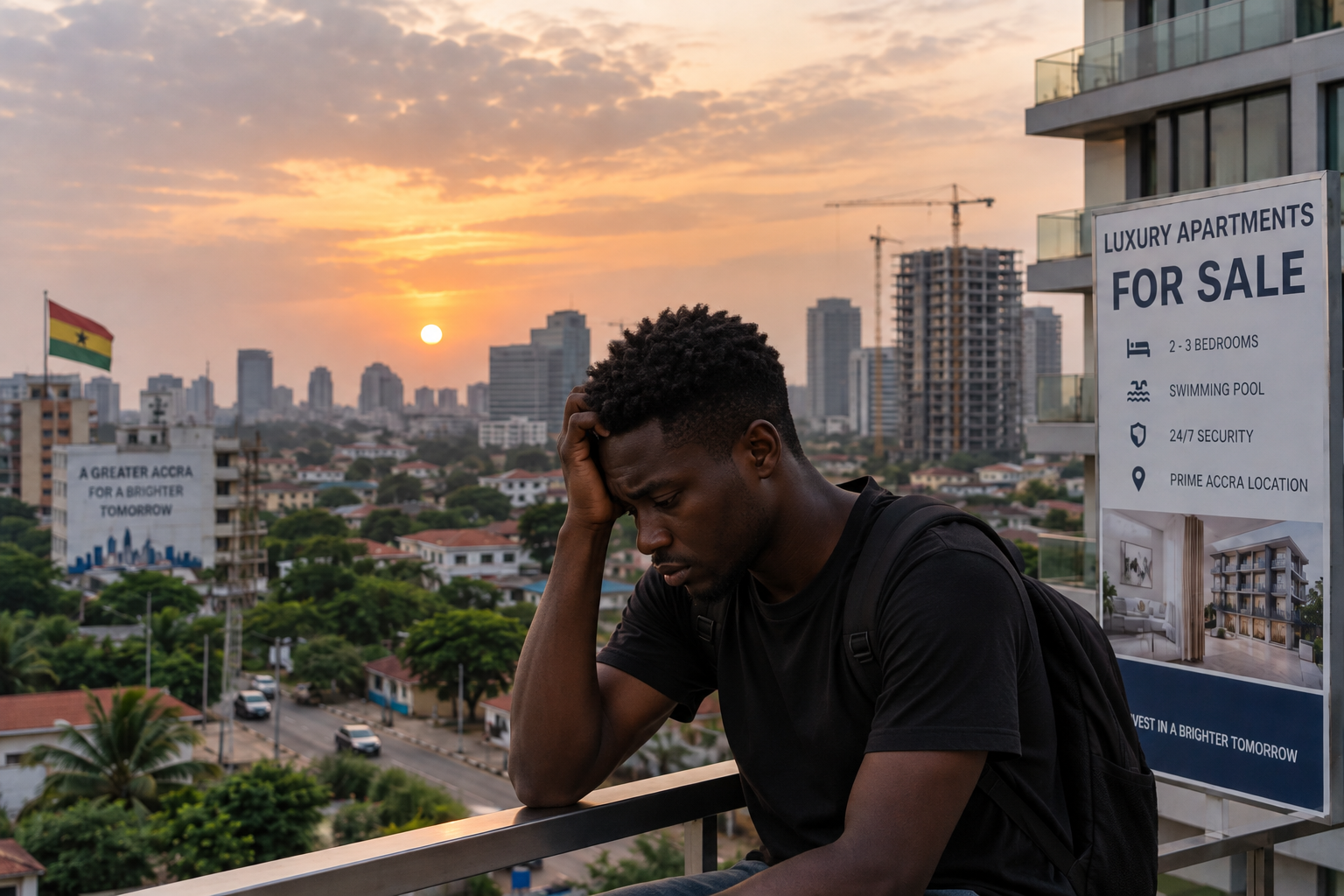
It sounds like a straightforward plan. But what happens when the amount you can realistically save bears little relationship to the price of the home you hope to buy?
That is the uncomfortable question at the heart of housing affordability in Accra.
Ghana’s housing debate is not simply about whether people are disciplined enough to save. Deloitte’s 2024 analysis of housing affordability examines the relationship between household earnings, essential expenditure and the money left for homeownership—an important reminder that a property price means little without understanding the buyer’s income.
The phrase “young Ghanaians may never afford homes in Accra” should be understood as a warning, not a prediction that an entire generation will remain permanently excluded.
When the route from earning an income to owning a home stops making financial sense, telling people to work harder is not a complete solution.
Watch the Full Kumadoh Perspective Episode
The Salary–House Price Gap: Why Saving Alone May Not Be Enough
A house is not affordable simply because it is cheaper than another house.
It is affordable when the buyer can realistically fund the purchase and its ongoing costs without sacrificing essential needs or depending on an unlikely financial breakthrough.
Deloitte’s April 2024 study cited Ghana Statistical Service figures indicating that more than 80% of public-sector workers earned below GH¢3,000 monthly as of February 2023. That is a historical public-sector statistic—not a current average salary for all Ghanaians—but it illustrates why income must be central to the housing conversation.
Consider this illustrative example, not a statement of current average salaries or Accra property prices:
| Item | Assumed amount |
|---|---|
| Target property price | GH¢800,000 |
| Monthly household take-home income | GH¢6,000 |
| Monthly savings towards the purchase | GH¢1,500 |
| Deposit at 20% of the purchase price | GH¢160,000 |
| Time needed to save the deposit | Approximately 8.9 years |
This calculation assumes the household starts without a deposit, saves consistently, earns no return on those savings and faces no change in the property price.
It also excludes transaction costs and emergencies.
The household is saving a substantial quarter of its take-home income. Yet it would still take almost nine years to accumulate the deposit alone.
The lesson is not that saving is pointless. It is that a large affordability gap cannot always be solved through budgeting alone.
A credible homeownership plan must consider the purchase price, income growth, existing savings, financing costs and the time available—not just the instruction to “save more.”
Mortgages in Ghana Exist, but Access Is Not the Same as Affordability
A mortgage can remove the need to pay the entire purchase price upfront. It does not remove the need to afford the debt.
For example, Stanbic Bank Ghana’s published Home Purchase product offers 80% financing and repayment periods of five to 20 years. Its information states that borrowing capacity depends on income and that the product carries a variable interest rate. Approval also requires life and property insurance. These are one lender’s published terms, not a universal offer to every applicant.
This creates two separate hurdles for a first-time buyer: raising the initial contribution and sustaining the repayments afterwards.
Return to the illustrative GH¢800,000 property. After a GH¢160,000 deposit, the remaining loan would be GH¢640,000.
At a hypothetical annual interest rate of 15%, repaid monthly over 20 years on a reducing balance, the principal-and-interest payment would be approximately GH¢8,427 per month.
That exceeds the example household’s entire GH¢6,000 monthly take-home income.
This is a mathematical illustration, not a current mortgage quotation. It assumes a constant rate throughout the term and excludes fees and insurance.
The point is clear: successfully saving a deposit does not automatically make the remaining purchase affordable.
Before committing to a property, ask the lender for a written assessment showing the full monthly payment, upfront charges, insurance costs and what could happen if the interest rate changes.
“You qualify for a loan” and “this loan leaves you financially secure” are different statements.
More Luxury Developments Do Not Automatically Mean More Affordable Homes
The presence of new buildings does not, by itself, tell us whether young professionals can buy them.
The Centre for Affordable Housing Finance in Africa’s 2024 Ghana profile described a mismatch between luxury accommodation aimed at higher-income earners and a continuing shortage of housing for lower-income households. This provides historical context for the distinction between building more homes and building homes that the intended population can afford.
Consider the difference between two development questions.
One asks: “What is the highest price this location could attract?”
The other asks: “What can the households who need to live here sustainably pay?”
Both concern housing, but they can produce very different projects.
There is nothing inherently wrong with housing for affluent local buyers, diaspora purchasers or international residents. The affordability problem arises when the homes available to a particular income group do not match that group’s purchasing power.
Blaming diaspora buyers alone is therefore too simplistic. The more useful question is whether the overall housing system provides realistic options across different budgets.
A city can have impressive new developments while still failing the people who need an attainable first home.
Construction Costs Make “Just Build Your Own House” an Incomplete Answer
When buying a completed home looks expensive, building independently can seem like the obvious alternative.
But “buy land and build gradually” is a project strategy—not proof of affordability.
CAHF’s 2024 Ghana profile identifies building-material costs, currency volatility, infrastructure gaps and land-registration costs among the pressures affecting housing delivery. It also describes the importance of incremental self-building in Ghana’s housing supply.
Before choosing this route, prepare a complete budget rather than comparing the price of a plot with the price of a finished house.
Your assessment should cover the land, professional services, documentation, approvals, construction, utility connections, external works, security and a contingency for unforeseen costs. Add the accommodation you will need while the house remains uninhabitable.
The right question is not:
“How much do I need to start?”
It is:
“How much do I need to reach a safe, usable home—and how will I fund each stage?”
A smaller, fully costed home may be a more realistic goal than a larger structure that consumes savings without providing somewhere to live.
Building can be a viable path to homeownership in Ghana. It should be chosen because the complete numbers work, not because the initial payment looks manageable.
Rent and Home Deposits Compete for the Same Savings
The 2021 Population and Housing Census found that 47.6% of households in Greater Accra occupied rented dwellings, while 36.4% lived in owner-occupied dwellings. These are regional household figures, not a measurement of young people’s individual ownership rates.
For a prospective buyer, rent is not an expense that disappears while saving for a deposit.
Research into graduate renters in Ghana, using an online survey conducted in 2020, found that savings were the preferred source of money for advance rent payments. The researchers expressly cautioned that their exploratory sample was not representative of all renters in Ghana.
The financial tension is easy to understand: the same savings may be expected to fund the next rental payment, provide an emergency reserve and build a future house deposit.
Where substantial rent is paid upfront, that money is unavailable for other immediate needs, even though it pays for accommodation over the following months.
This is why renting versus buying in Ghana should not be reduced to the claim that “rent is wasted money.”
Rent buys somewhere to live. The relevant comparison is whether purchasing an appropriate home would improve the household’s overall position after accounting for financing, maintenance, mobility and risk.
Buying too early is not automatically wiser than renting with a realistic plan.
Moving Farther Away Can Lower the Price but Raise Other Costs
Before treating a lower-priced home as affordable, examine what living there would require.
What would the commute cost? How much time would it take? Would the household need another vehicle? Are schools, healthcare and everyday shopping reasonably accessible?
Compare the total monthly cost of living in the property—not just the mortgage or advertised purchase price.
A cheaper house can be a sound choice when its location fits your work and family needs. It can be a poor choice when the apparent saving is absorbed by transport, additional services or an impractical daily routine.
A useful test is to make the journey at the times you would normally travel. Visit the area under different conditions, inspect access and drainage, and verify the services you would depend on.
The goal is not to buy the cheapest property on a map. It is to find a home whose complete cost fits your life.
Young Ghanaians Should Not Confuse Financial Progress With Owning a Particular Address
There is a difference between wanting a secure home and feeling pressured to purchase a property that proves success.
A prestigious address should not require a household to abandon emergency savings, neglect essential responsibilities or take on debt that only works under perfect conditions.
Ask yourself a difficult question:
“Am I choosing this property because it meets my needs, or because I want other people to believe I have arrived?”
This is not an argument against ambition. It is an argument for separating ambition from financial overextension.
A first home does not have to be the final dream home. A smaller apartment, a modest completed house or a longer period of planned renting may deserve consideration alongside a detached house in a preferred neighbourhood.
None of those choices should be treated as personal failure.
What Can First-Time Home Buyers in Ghana Do?
Personal planning will not solve every structural housing problem. It can, however, help a buyer avoid making the situation worse.
Start With an Affordable Monthly Commitment
Work backwards from reliable take-home income and essential expenditure.
Allow for existing debt, dependants, maintenance, insurance and emergencies before deciding what housing payment is sustainable. Test the budget against an interruption to income rather than assuming every month will be a good month.
A property search becomes more useful when it begins with a credible spending limit.
Make Your Finances Easier to Assess
Keep clear records of earnings, savings and business activity.
Stanbic’s published eligibility information, for example, includes permanently employed applicants on structured salaries and self-employed applicants with good business financials. That makes documented income an important consideration—not simply the amount someone believes they can earn in a good month.
Obtain a financing assessment before paying a substantial non-refundable commitment towards a home.
Compare the Full Route, Not Just the First Payment
Evaluate a completed purchase, mortgage, developer instalment arrangement and self-build plan on comparable terms.
For each option, identify the total expected cost, payment timetable, completion requirements and consequences of delay or default. Include service charges and maintenance rather than focusing only on the advertised deposit.
Have independent, appropriately qualified professionals review the property, documentation and contract before you commit.
A payment plan that makes entry easy can still make completion difficult.
What Would Make Housing Affordability in Accra Better?
My view is that the response should focus on the distance between household incomes and the complete cost of decent housing.
Affordable housing programmes should define the households they are intended to serve. “Affordable” should refer to a realistic income and payment capacity, not merely a discount from a more expensive development.
Financing should also be assessed alongside supply. Helping buyers borrow more is not enough when the resulting repayments remain unmanageable.
Practical priorities should include well-serviced land, transport connections, attainable smaller homes, transparent development costs and reliable rental options.
Rental housing deserves a place in that discussion. A functioning housing system should offer security to people who are not ready—or do not yet have the means—to buy.
The measure of progress should not simply be how many buildings are announced. It should be how many households gain access to suitable homes they can sustain.
Frequently Asked Questions
Does this mean young Ghanaians will never own homes in Accra?
No. The title describes a risk, not a certain outcome. The illustrative calculations show how ownership can become unrealistic when a target property’s cost is too large relative to a household’s savings and income. Changing those assumptions changes the result.
Are mortgages available for first-time buyers in Ghana?
Mortgage products are available, but eligibility and affordability must be assessed individually. Stanbic’s published home-purchase information, for example, describes income-dependent lending and borrower eligibility requirements. A product’s existence does not guarantee approval or an affordable repayment for every buyer.
Is building a house cheaper than buying one in Ghana?
There is no universal answer. Compare a complete, professionally prepared building budget with the full cost of buying an equivalent finished property. Include land, infrastructure, supervision, accommodation during construction and contingencies.
How much should I save before buying a home?
Use the requirements of the actual property and financing arrangement—not a generic figure. Your target should account for the deposit, transaction expenses, initial repairs or furnishing, and an emergency reserve that remains available after completion.
Final Thoughts: The Housing Dream Needs a Realistic Route
The concern is not simply that some houses are expensive. It is whether a young household can identify a credible route from today’s income to tomorrow’s ownership.
A plan that depends on an exceptional salary increase, uninterrupted savings and permanently favourable conditions deserves to be questioned.
Young Ghanaians should be encouraged to plan carefully, improve their earning capacity and protect their money. But those individual responsibilities should not become an excuse to ignore the need for housing that matches realistic budgets.
The dream of homeownership should be supported by workable numbers—not sustained by pressure to buy at any cost.
What is the biggest barrier to owning your first home in Accra: the deposit, monthly repayments, property prices or confidence in the available options?
Share your perspective in the comments and subscribe to Kumadoh Perspective for more conversations about real estate, business and investment in Ghana.
This article provides general educational information, not personalised financial or legal advice. All numerical scenarios are illustrative. Verify current prices, financing terms and property documentation before making a commitment.